The Whiskey Rebellion
Pour a glass of rye and you are holding the spirit that first tested whether the United States would hold together. In the earliest years of the new nation under its Constitution, the fiercest challenge to federal authority did not come from a foreign power or a border war. It came from a tax on whiskey — and it grew serious enough that the President of the United States personally took the field at the head of nearly thirteen thousand men. This is where the American whiskey story and the American story become, for a moment, the same story.
At The Sentinel Room we pour American whiskey with a sense of where it comes from. It comes, in part, from here: from a rebellion over a still tax that the founders had to answer with an army, and from the rugged Pennsylvania rye that lit the fuse.
Hamilton's Tax
The trouble began with a debt. The Revolution had been won on borrowed money, and by 1790 the new federal government had agreed to assume the war debts of the states — tens of millions of dollars it had no obvious way to pay. Alexander Hamilton, the first Secretary of the Treasury, needed revenue, and he wanted to establish that the federal government could reach into the country and collect it. His instrument was an excise on distilled spirits, passed in March 1791 — the first federal tax ever laid on a domestic product. History remembers it simply as the whiskey tax.
To Hamilton it was tidy statecraft: a tax on a non-essential good, easier to defend than a tax on land, that would fund the debt and flex the government's new constitutional muscle at the same time. To the farmers of western Pennsylvania it was something closer to an insult — and, as we explored in the story of whiskey as frontier money, a tax laid directly on their currency and their cash crop.
The law's structure sharpened the grievance. It let large eastern distillers pay a flat annual fee that worked out to a low rate per gallon, while small, seasonal frontier distillers paid a higher effective rate on everything they made. A tax that fell hardest on those least able to pay it, collected in the scarce hard coin the frontier conspicuously lacked — it was, to the western farmer, a law written by easterners for easterners.
The Rye Country Rises
The country that rose up was rye country. West of the Alleghenies, farmers distilled their grain into Monongahela rye — a robust, high-rye Pennsylvania style named for the river valley at the heart of the trouble — because whiskey was the only practical way to get the value of a harvest over the mountains to market. Taxing it struck at the foundation of the frontier economy.
Resistance was immediate and physical. As early as September 1791, a tax collector named Robert Johnson was seized, stripped, and tarred and feathered by a disguised gang in Washington County. Intimidation of that kind — the tar bucket, the liberty pole, the midnight visit — recurred for three years across the western counties, and federal authority in the region effectively ceased to function. Collectors could not collect; some could not even find lodging.
Matters came to a head in the summer of 1794. In mid-July, a U.S. marshal and the regional tax inspector, General John Neville, tried to serve writs on delinquent distillers. Militiamen surrounded Neville's fortified house, Bower Hill; in the exchanges of July 16th and 17th, shots were fired, the rebel leader Major James McFarlane was killed under a flag of truce, and the enraged crowd — several hundred strong by then — burned Neville's home to the ground. Two weeks later, on August 1st, some seven thousand people gathered at Braddock's Field near Pittsburgh, with loose and dangerous talk of marching on the town. The frontier was, by any honest measure, in open insurrection.
The President Takes the Field
Washington's response is the part everyone half-remembers and few remember precisely — so let us be precise, because the truth is more interesting than the slogan.
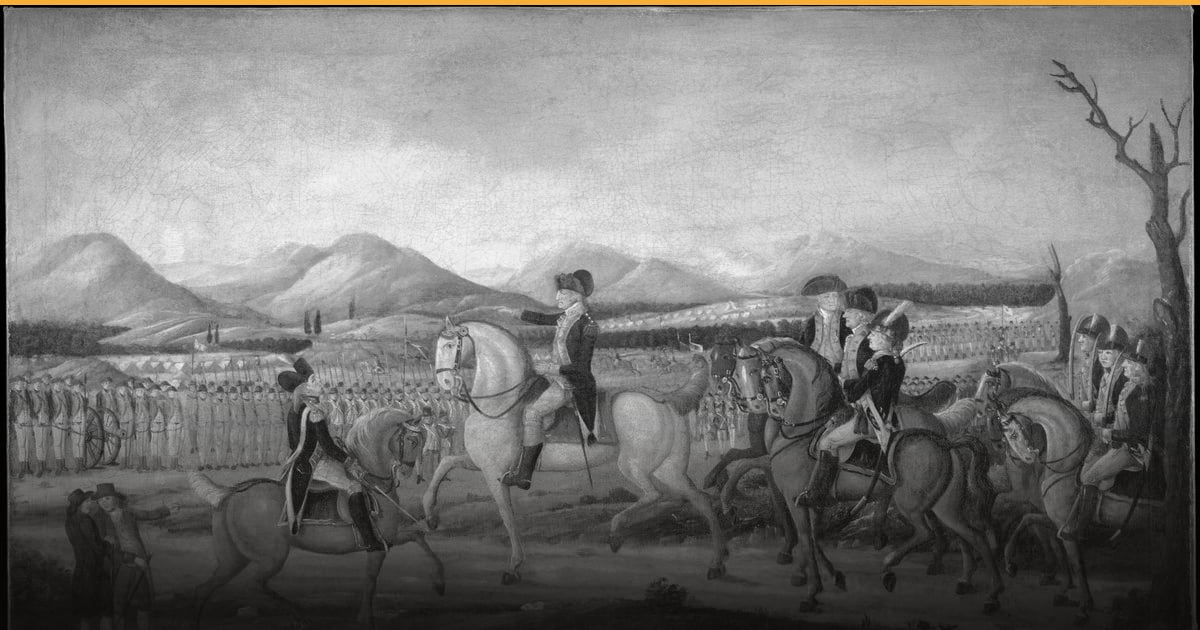
Under the Militia Act of 1792, a Supreme Court justice certified that western Pennsylvania was in a state of rebellion beyond the reach of the courts, clearing the way for the President to call up the militia. Washington federalized a force from Virginia, Maryland, New Jersey, and Pennsylvania — the best-supported figure is 12,950 men, which is why you'll see it rounded to "nearly 13,000." It was an army larger than most Washington had commanded during the Revolution itself, raised to put down not the British, but his own citizens.
Then he did something all but unique in American history: he rode out to lead it in person. In late September 1794 Washington left Philadelphia, reviewed the troops, and traveled west with them as far as Bedford, Pennsylvania. Here the honest account parts from the legend. Washington did not ride into the rebel counties at the head of a charge — there was no charge to make. From Bedford he handed field command to Henry "Light-Horse Harry" Lee, the Governor of Virginia, with Hamilton accompanying the army as civilian adviser, and returned to the capital. The claim you'll hear — that he is the only sitting president to take the field at the head of an army he personally commanded — is true, and worth savoring, so long as you state it with care. (Two decades on, in 1814, President James Madison rode toward the British at the Battle of Bladensburg and briefly came under fire — but as a bystander near the front, not as the commander of the troops, which is why the distinction still belongs to Washington.) He led his army to the staging ground, in other words, not into a battle, because the battle never came.
The Rebellion That Vanished
For all the muster and menace, the Whiskey Rebellion ended not with a clash but with an anticlimax. As the federal army advanced into the western counties in October, the insurrection simply evaporated. The rebels melted back into their farms; there was no pitched battle, no last stand, scarcely a shot fired in anger. The soldiers, poorly trained and ill-supplied, foraging from the countryside as they went, were mockingly dubbed the "Watermelon Army" by the very rebels they had come to suppress.
The aftermath was as restrained as the march had been overwhelming. Around 150 men were arrested; roughly two dozen were indicted for treason; and in the end just two — Philip Wigle and John Mitchell — were convicted and sentenced to hang. Washington pardoned them both. He had made his point, and he knew it did not require a gallows.
The point was the whole reason the episode matters. A decade earlier, under the toothless Articles of Confederation, the government had been unable to muster a response to Shays' Rebellion in Massachusetts. Now, under the Constitution, the federal government had proven it could enforce its own laws across hundreds of miles of hostile country — decisively, and without tipping into tyranny. The new republic would hold. And it had been a tax on whiskey, of all things, that put it to the test.
Drink the Rebels' Whiskey
The remarkable thing is that you can still, in a real sense, drink the whiskey the rebellion was fought over. Reach for a pour of Old Overholt Straight Rye Bottled in Bond from our whiskey library.
Here is the honest lineage, because this series does not gild its pours. Old Overholt traces to Abraham Overholt's distillery in West Overton, Pennsylvania, formalized around 1810 — which means the brand itself post-dates the 1794 rebellion by a decade and a half, and today the whiskey is made in Kentucky, not Pennsylvania. What it genuinely carries forward is the tradition: it is arguably the closest widely available descendant of the Monongahela rye the rebels distilled, from the same region and the same high-rye grain. Bottled in bond at 100 proof, it is a spice-forward, old-style American rye that drinks like the frontier that made it.
Order it neat, and raise it to the stubborn Pennsylvania farmers who fought the new government over a still tax — and to the president who answered them with an army, and then, having won, sent everyone home. It is a very American story, and it fits in a glass.
---
What's Documented, and What's Legend
In the spirit of getting it right, here is the honest ledger behind this article:
- Well documented: Hamilton's March 1791 excise as the first federal tax on a domestic product, laid to service assumed war debt; the regressive flat-fee-vs-per-gallon structure that burdened small distillers; the tarring-and-feathering of collectors (Robert Johnson, September 1791); the July 1794 attack on John Neville's Bower Hill and the death of James McFarlane; the ~7,000-person Braddock's Field muster (August 1, 1794); the federalized force of ~12,950; the collapse without a battle; ~150 arrests, two treason convictions (Wigle and Mitchell), both pardoned by Washington.
- Stated carefully: that Washington is the only sitting U.S. president to take the field at the head of an army he personally commanded — accurate, but he accompanied them only to Bedford before handing command to Henry Lee, and there was no combat. (The near-exception is President Madison, who rode toward the fighting at Bladensburg in 1814 and came under fire, but did not command the troops — noted in the text so the claim isn't overstated.) The "Watermelon Army" nickname is real; its exact foraging etymology is folk tradition.
- Kept qualitative: the precise per-gallon cents of the tax (sources vary; the direction — small distillers paid more — is solid); and the rebel headcounts at Bower Hill, which describe different days (the July 16 skirmish vs. the July 17 assault) and should not be merged.
Keep Reading
- Liquid Money: how whiskey became the frontier's currency
- President Distiller: George Washington's Rye
- The Rye Revival: rediscovering America's spiciest spirit
References
This article was fact-checked against primary and institutional sources. Follow the links to verify:
- Whiskey Rebellion (well-cited overview: tax, escalation, muster, troop figure, trials)
- George Washington's Mount Vernon — The Whiskey Rebellion
- American Battlefield Trust — The Whiskey Rebellion
- U.S. House of Representatives, History, Art & Archives — The 1791 Excise Whiskey Tax
- TTB (U.S. Treasury) — The Whiskey Rebellion
- National Park Service — Whiskey Rebellion (Bower Hill)
- Pennsylvania Heritage — The Whiskey Boys Versus the Watermelon Army
- Old Overholt — Monongahela rye lineage, founding ~1810, now made in Kentucky
Books (no link): Reid Mitenbuler, Bourbon Empire (2015); and standard accounts of the rebellion (e.g., William Hogeland, The Whiskey Rebellion, 2006).
Drink responsibly. The Sentinel Room serves rye and bourbon to guests 21 and over.