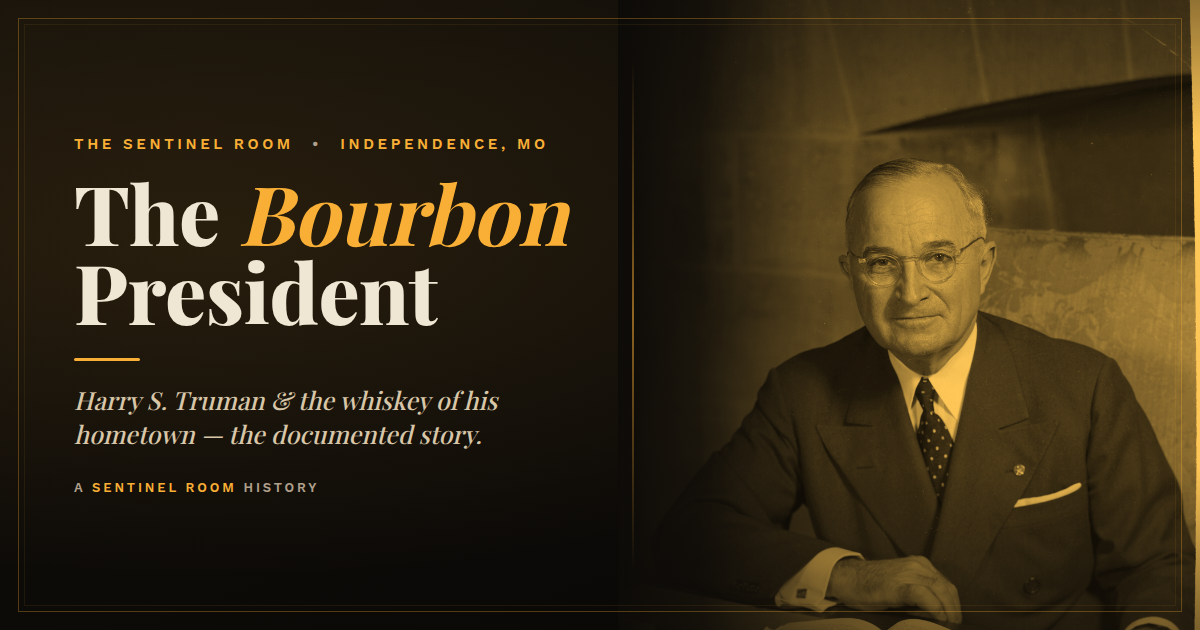
The Bourbon President: Harry Truman of Independence
A few minutes' drive from where you are sitting, at 219 North Delaware Street, stands a white Victorian house the world once called the Summer White House. It belonged to Harry S. Truman — farmer, haberdasher, artillery captain, county judge, senator, and the thirty-third President of the United States. He is the most famous citizen Independence, Missouri has ever produced, and by the plain evidence of the historical record he was also a bourbon man.
At The Sentinel Room we pour American whiskey in the town Truman called home for more than half a century. So it is worth telling his bourbon story properly — not the gauzy legend that circulates online, but the documented truth, with the folklore set carefully to one side. The real account is more interesting than the myth, and it is rooted right here in Jackson County.
A Missouri Man, Through and Through
Truman was born in Lamar, Missouri, on May 8, 1884, and in 1890 his family moved to Independence. He grew up here. He met Bess Wallace in Sunday school as a boy, courted her for years largely by letter while he farmed near Grandview, and on June 28, 1919, married her at Trinity Episcopal Church on the Independence square. He moved into the Wallace family home at 219 North Delaware and kept it as his home, between stints in Washington, from then until his death on December 26, 1972. That house is now the heart of the Harry S. Truman National Historic Site, run by the National Park Service, and Truman is buried a short distance away in the courtyard of his presidential library, in a spot he chose himself.
Before politics, there was a store. In November 1919, Truman and his Army friend Eddie Jacobson opened a haberdashery — a men's furnishings shop selling shirts, hats, gloves, and belts — at 104 West 12th Street in downtown Kansas City, across from the Muehlebach Hotel. It did well for a season and then collapsed in the sharp postwar recession of the early 1920s. (A note for the record: it was the economy that sank the store, not Prohibition, despite a tidy myth to the contrary — the shop sold clothing, not liquor.) Jacobson took bankruptcy; Truman refused to, and spent more than a decade quietly paying off his share of the debt. That stubborn, plain-dealing honesty tells you who the man was — and his taste in whiskey ran exactly the same way. There was nothing fussy about it.
It is impossible to talk about Truman's rise without the world he rose through. This was Tom Pendergast's Kansas City — the "Paris of the Plains," a wide-open town that treated Prohibition as a polite suggestion. Pendergast himself had come up through saloons and the wholesale liquor trade; Missouri voters had rejected statewide prohibition three separate times, in 1910, 1912, and 1918; and the city's distilling and brewing trade was old and deep. It was that machine that launched Truman's political career — and, as it happens, it did so directly across the street from where you are sitting. Truman emerged from a Missouri that was, by temperament, decidedly wet.
The Career That Began Across the Street
Here is a detail worth raising a glass to, because it unfolded a few dozen feet from your barstool: the political career that ended in the White House was set in motion right across Lexington Avenue from The Sentinel Room.
It started in the failing haberdashery. Sometime in the summer of 1921, James Pendergast — Tom Pendergast's nephew and one of Truman's fellow artillery officers from the war — walked into the store on West 12th Street with his father, Michael "Mike" Pendergast, who ran the machine's operations out in the rural, eastern reaches of Jackson County. Mike was hunting for a clean, well-liked veteran with farm-country roots to carry the machine's banner in the country precincts, and he asked Truman — then watching his store sink in the recession — whether he would run for judge of the county court's Eastern District. Truman said yes.
The deal was made public the following spring. In April 1922, the Rural Jackson County Democratic Club gathered in an upstairs room at 211 West Lexington Avenue, on the Independence Square, and Mike Pendergast stood up and told the assembled local Democrats that their candidate for Eastern Judge would be an obscure haberdasher named Harry S. Truman — a choice that, by some accounts, blindsided a few men in the room who had wanted the nod for themselves.
That building still stands on the square today. Step out the door of The Sentinel Room at 208 West Lexington, look across the street, and you are looking at the room where Harry Truman's road to the presidency began.
The Morning Shot
The most repeated story about Truman and bourbon is also among the better attested. By the account of the Truman Little White House in Key West, the President began his day with a shot of bourbon, taken on the advice of his physician, followed by a large glass of orange juice. In David McCullough's biography Truman (1992), the regimen is rendered a little differently — an egg, a slice of toast, a strip of bacon, a glass of skim milk, and a shot of Old Grand-Dad, with the bourbon taken after his brisk morning walk. (The two best accounts don't perfectly agree — the Little White House says orange juice, McCullough's breakfast says skim milk — a small discrepancy worth noting rather than smoothing over.) The bourbon, by McCullough's telling, "got the engine running."
That walk was its own institution. The Truman Library records his pace at a soldier's 120 steps a minute — quick-time cadence "as he had learned to do in the Army" — covering a mile or two while reporters and Secret Service struggled to keep up. The National Park Service still runs an "On Pace with President Truman" challenge built around it. In Washington he was up around half past five in the morning; on vacation in Key West he allowed himself a luxurious 7:30, "some two hours later than his Washington routine," which neatly explains the conflicting wake times you'll find quoted.
A word of honesty here, because it matters: no primary source specifies the size of that morning pour — "a shot" is as precise as the record gets — and the sequence (before the walk or after) is told both ways. The romance of the ritual has hardened a few soft details into false certainties. What is solid is the gist: an old soldier, openly and without apology, started his disciplined day with a small bourbon and a fast walk.
So What Did He Actually Drink?
Here the honest answer is more interesting than the marketing one: there is no documented single "favorite." What the record shows is a preference described by serve more than by brand — an Old Fashioned, or bourbon cut with plain water, the old Southern "bourbon and branch." Every careful source declines to crown one bottle, and instead names a pair.
Old Grand-Dad is the best-attested of the two — it is the brand McCullough names in the morning-ritual passage, and the one most consistently tied to Truman in the accounts that followed. In his day it was a National Distillers mainstay, sold famously as a 100-proof, bottled-in-bond high-rye carrying the old Basil Hayden family lineage. Sturdy, traditional, unsweet: a fitting glass for the man.
Wild Turkey is the co-named favorite, and it clears a trap worth mentioning, because people assume it is too modern for Truman. It isn't: the Wild Turkey name dates to 1940 and the 101-proof bourbon was first bottled by Austin, Nichols & Co. in 1942 — three years before Truman took office. (In his era it was a small, sourced-and-bottled label, not yet the icon it became, so "Truman always drank Wild Turkey" overstates a thin record — but the bottle genuinely existed, and he is repeatedly named with it.)
You will also see Old Forester and Old Crow listed as Truman bourbons. Treat those as period color rather than documented fact — they appear mostly in enthusiast retellings without a primary citation. They are, however, perfect scene-setting for the era: Old Forester, the Brown-Forman brand that bills itself as the first bourbon sold exclusively in sealed bottles and one of the handful of distilleries licensed to sell medicinal whiskey straight through Prohibition; and Old Crow, the National Distillers powerhouse that was the best-selling bourbon in America right up until the 1950s. This was the whiskey landscape Truman drank in — robust, rye-recipe, bottled-in-bond Kentucky bourbon, the unpretentious standard of mid-century America.
The Old Fashioned That Wasn't
The best Truman bourbon story unfolds not in Independence but in the White House, and it has earned its place in cocktail lore because, unusually, it traces to a first-hand source: the memoir of chief butler Alonzo Fields, My 21 Years in the White House (1960), retold by McCullough.
When the Trumans arrived in 1945, the First Lady asked Fields — an accomplished bartender — for a pair of Old Fashioneds. He built them the proper way: bourbon, sugar, bitters, fruit, served cold. The Trumans found them too sweet. The next night he cut the sugar; this time, they said, it tasted like fruit punch. So Fields gave up on garnish entirely and simply poured bourbon over ice. Bess Truman tasted it and delivered the verdict that has outlived everyone at the table: "Now that's an old-fashion." The President agreed.
In other words, the Truman "Old Fashioned" was, at the family's insistence, little more than good bourbon over ice — stiff and barely seasoned, the sugar and fruit stripped away. (The exact wording of Bess's line survives in a couple of slightly different forms; the sense of it never changes.) It is a small, revealing anecdote. The Trumans wanted their whiskey to taste like whiskey.
Bourbon, Branch Water, and the Poker Table
The fuller picture of Truman the drinker is social, not solitary — and the most reliable evidence for it isn't in bourbon blogs but in the National Archives. Truman ran regular, serious poker games with a rotating circle of friends and officials: Treasury Secretary (later Chief Justice) Fred Vinson, his favorite partner; Stuart Symington; Clinton Anderson; military aide Harry Vaughan; Admiral William Leahy; and Clark Clifford, who often organized them. Each player started with a $500 stack of chips, and a tithe of every pot went into a "poverty bowl" that was doled back out to whoever got cleaned out — a characteristically Trumanesque touch of fair play.
The games sailed with him. His favorite venue was the presidential yacht USS Williamsburg, on weekend cruises down the Potomac, and they ran late into the night on the porch of the Key West Little White House. The most famous hand of all came aboard the train to Fulton, Missouri, in March 1946 — the trip for Churchill's "Iron Curtain" speech — when Winston Churchill joined the game, played badly, and retired down a couple hundred dollars, prompting Harry Vaughan's immortal verdict that the great man was "a pigeon."
And then there is the line Truman delivered to Justice Hugo Black at a cocktail party in 1952, not long after the Supreme Court had struck down his seizure of the steel mills: "Hugo, I don't much care for your law, but, by golly, this bourbon is good."
The Measure of the Man
It would be easy, and wrong, to leave you with the cartoon of a "bourbon-soaked" president. The people who actually watched him drink tell a different story. His lifelong friend Edgar Hinde, in an oral history kept at the Truman Library, put it memorably: "He can make a highball last longer than anybody I ever saw," adding that he never once saw Truman anywhere near the influence of liquor. The morning shot, Truman said, was taken on his doctor's advice — though it pays to be precise about that, because the only real source for the "doctor ordered it" line is a 1972 recollection by his son-in-law, no physician is named, and Truman's own 1947 diary records a diagnosis of cardiac asthma. Treat the medical rationale, then, as family lore rather than a prescription. What isn't in doubt is the moderation: a small bourbon to start the day, a watered highball he nursed for hours, a single Old Fashioned before dinner — a disciplined, Midwestern way of drinking, entirely of a piece with the plain-spoken "common man" Truman was proud to be. Bourbon fit his brand precisely because it was honest, American, and unpretentious — the same things he claimed for himself.
Drink the Way Truman Drank
There is something fitting about pouring bourbon a few minutes from Truman's front porch. The thirty-third President carried the unfussy good sense of this town into the highest office in the land, and he carried his whiskey the same way: neat in spirit, honest in taste, no decoration required.
If you'd like to drink the way Harry Truman drank, the recipe could not be simpler. Reach for a sturdy, traditional, bottled-in-bond bourbon — an Old Grand-Dad puts you squarely in his company, and a high-proof Wild Turkey is no anachronism (both live on the shelves of our whiskey library). Pour it over ice, or cut it with a little plain water as he often did. Resist the urge to add anything else. That is the Truman Old Fashioned, and it is, more or less, a fine pour of straight bourbon wearing a cocktail's name.
Order it neat, raise the glass toward North Delaware Street, and you are drinking a piece of Independence history — exactly as its most famous citizen preferred it.
---
What's Documented, and What's Legend
In the spirit of getting it right, here is the honest ledger behind this article:
- Well documented: Truman's regular poker games, the players, and the Williamsburg/Key West venues (National Archives); the fast 120-paces-a-minute morning walk (NPS; Truman Library); the morning bourbon as reported by the Truman Little White House; the Alonzo Fields Old Fashioned story (Fields' 1960 memoir; McCullough); Old Grand-Dad as the best-attested brand (named by McCullough); his moderation (Edgar Hinde oral history); the Hugo Black bourbon line (via Justice Douglas, in McCullough); and the local Independence facts — the house, the wedding, the haberdashery (NPS; Truman Library).
- Plausible but thin: the exact size of the morning pour; Wild Turkey as a true co-favorite (named often, but resting largely on one biography); whether the shot came before or after the walk; and the exact wording of Bess's Old Fashioned verdict, which survives in two slightly different forms.
- Set aside as folklore or marketing: any single "favorite bourbon"; Old Forester and Old Crow as documented Truman brands; the idea that a physician formally prescribed the morning bourbon (the only source is a later family recollection, and Truman's documented condition was cardiac asthma); the notion that Prohibition closed his haberdashery; and any ornate "best Old Fashioned you've ever made" quote.
Keep Reading
- What makes a bourbon a bourbon — the complete guide
- The Rye Revival: rediscovering America's spiciest spirit
- Kansas City's Genesis: the frontier town that shaped Truman's world
References
This article was fact-checked against primary and institutional sources. Follow the links to verify:
- Harry S. Truman Library & Museum — 219 North Delaware Street
- National Park Service — The Truman Home (Harry S. Truman National Historic Site)
- Truman Library — Wedding of Bess Wallace & Capt. Harry S. Truman (June 28, 1919)
- National Park Service — Trinity Episcopal Church of Independence
- Truman Library — Truman & Jacobson Haberdashery (104 W. 12th St.)
- The Pendergast Years — Harry Truman and the Pendergast Political Machine
- State Historical Society of Missouri — Thomas J. Pendergast
- Jackson County Historical Society — "Truman's First Campaign" (the 1921 haberdashery pitch & 211 W. Lexington announcement)
- Alcohol Laws of Missouri — statewide prohibition rejected 1910, 1912, 1918
- Truman Little White House — The Daily Schedule (morning bourbon, orange juice, the walk)
- National Park Service — "On Pace with President Truman" challenge
- U.S. National Archives, Prologue — "Harry Truman, Poker Player"
- Richard Langworth — Churchill, Truman & Poker on the Train to Fulton (March 1946)
- Truman Library — Edgar G. Hinde Oral History ("make a highball last longer…")
- Truman Library — Alonzo Fields Papers (the Old Fashioned anecdote)
- Truman Library — Dr. Wallace H. Graham Oral History (Truman's physician)
- Health & Medical History of President Harry S. Truman (cardiac asthma, 1947 diary)
- Youngstown Sheet & Tube Co. v. Sawyer (1952 steel-seizure ruling — context for the Hugo Black quip)
- Wild Turkey (bourbon) — name 1940, first bottled by Austin Nichols 1942
- Old Grand-Dad — National Distillers era, high-rye, Basil Hayden lineage
- The Daily Beast — "How Harry Truman Ran a Bourbon-Soaked White House"
Books (no link): David McCullough, Truman (Simon & Schuster, 1992) — the standard biography; and Alonzo Fields, My 21 Years in the White House (1960) — the butler's first-hand memoir.
Drink responsibly. The Sentinel Room serves bourbon to guests 21 and over.