The Cocktail Comes West: The Frontier Ancestor of the Drink in Your Hand
The drink in your hand has an ancestor, and it's older than the state you're drinking it in. When we hand you an Old Fashioned across the counter, we're handing you a recipe that was already being described in print more than two hundred years ago — a recipe that rode west with the wagons, got improvised in frontier saloons, and came all the way back around to the stool you're sitting on tonight. This is the last piece in our Kansas City whiskey history series, and it ends where the whole thing lives: in a glass.
What a "Cocktail" Originally Was
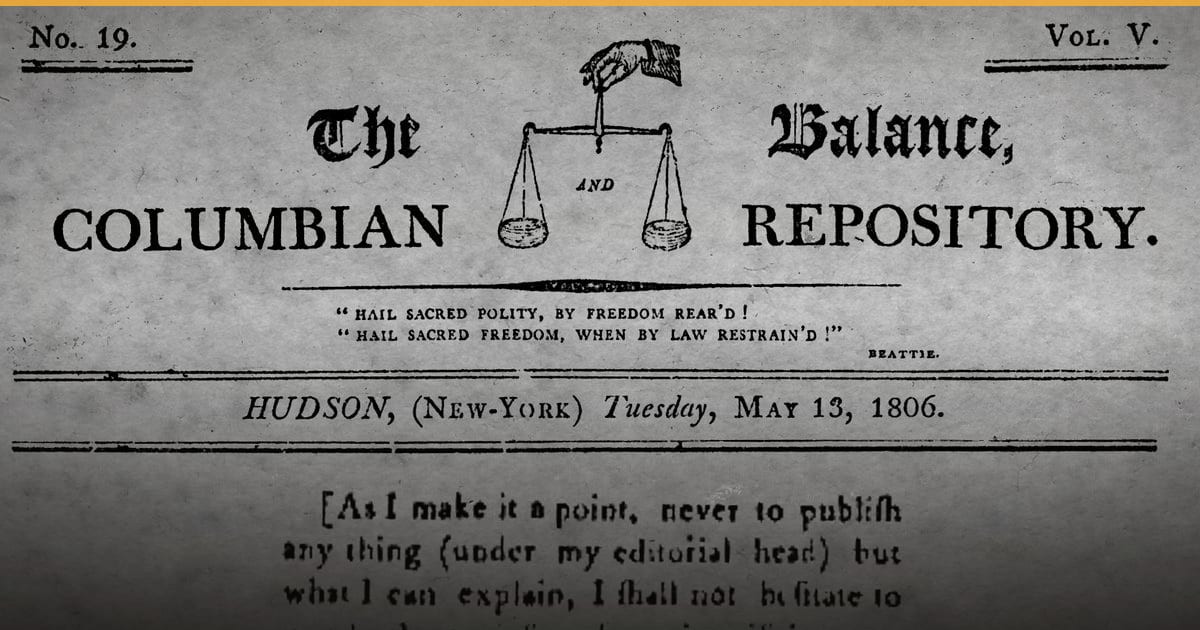
Here's a fact that delights us every time. The very first published definition of the word "cocktail" appeared in a newspaper — The Balance and Columbian Repository of Hudson, New York — on May 13, 1806. A reader had written in demanding to know what this odd new word meant, and the editor answered: a cocktail is
> "a stimulating liquor, composed of spirits of any kind, sugar, water, and bitters."
Read that again slowly: spirits, sugar, water, and bitters. That is, almost to the letter, an Old Fashioned. The original definition of the word "cocktail" is the Old Fashioned. Every elaborate concoction that has ever carried the name — every Cosmo and every espresso martini — traces its family tree back to that one simple four-part formula. The editor even noted it was "vulgarly called a bittered sling." The oldest cocktail is the one we still build every night.
How It Rode West
Now carry that 1806 formula out onto the frontier we've spent this series exploring — the trails, the outfitting towns, the rough whiskey. Two of the four ingredients were easy: spirits (rough as they were) and water. The other two were small luxuries.
Bitters came west partly disguised as medicine. Bitters were sold as digestive tonics and cure-alls — concentrated botanical remedies — and a bottle of bitters was a respectable thing to own on the frontier for entirely "medicinal" reasons. That a few dashes also turned harsh whiskey into something approaching a cocktail was a happy coincidence nobody complained about. Sugar and, especially, ice were genuine luxuries — ice in particular was precious and seasonal on the frontier, which is part of why so much early whiskey was simply drunk neat or with plain water.
So the frontier saloon's "cocktail" was often a rough approximation of that 1806 ideal: harsh spirit, a little sugar if you had it, bitters if you were lucky, water more often than ice. But the formula was traveling, and it survived. As towns grew and ice and sugar and better whiskey became available, that bittered-sling formula could finally be built the way the 1806 editor meant it — and people started asking for it by a telling name: make it the "old-fashioned" way. The drink was named, in effect, out of nostalgia for the original cocktail.
The Truman Footnote
We can't end this series without closing the loop we opened in the very first article. Remember President Harry Truman, Independence's own, and his idea of an Old Fashioned? When the White House butler built the Trumans a proper one — bourbon, sugar, bitters, fruit, the works — they found it too sweet. Cut the sugar: too fruity. Finally the butler gave up and just poured good bourbon over ice, and Bess Truman pronounced, "Now that's an old-fashion."
The Trumans, without knowing it, had argued their way almost all the way back to the 1806 original — stripping the drink down toward spirits, a whisper of sweetness, and not much else. The frontier formula, the presidential preference, and the modern craft-cocktail ideal all point at the same thing: an Old Fashioned should taste, fundamentally, like good whiskey. Everything else is garnish.
The Series Ends Where It Lives
We started this series two hundred years and thirteen articles ago — with a president's bourbon, a building's secret history, a frontier town, a wide-open city, a boss, a sound, a river, a law, and a long argument about grain. All of it, in the end, pours into a single glass in a single cocktail lounge on the Independence Square.
So here is the only possible ending. Let us build you an Old Fashioned with Old Grand-Dad Bonded — a bottled-in-bond bourbon, honest to the 1897 law we celebrated, and the very brand that got President Truman's engine running a few blocks from here. Spirits, sugar, bitters. The oldest cocktail there is, made the old-fashioned way, in a room where a Sentinel once ran its press, on a Square where the wagons once loaded up for the West.
That's the whole history, and it fits in your hand. Come drink it with us. We'll be here — the city that never closed, one more Old Fashioned at a time.
This concludes our Kansas City whiskey history series. Every bottle mentioned is poured at The Sentinel Room, 208 W Lexington Ave, on the Independence Square. Come read the bricks — and taste the history — in person.