The Whiskey Town Before the Trails: Independence as the Frontier's Supply Hub
The wagons that left from these streets carried barrels you'd recognize. Not the aged, labeled, carefully-made bourbon on our shelves — but whiskey, unmistakably, packed in among the flour and the gunpowder, headed west into a country that had almost none of it. For a couple of decades in the middle of the nineteenth century, the ground around this Square was one of the busiest commercial staging areas in America, and whiskey was part of nearly every load.
This is the third piece in our Kansas City whiskey history series, and it steps back before the machines and the speakeasies to the very beginning — to the moment Independence was the edge of the map, and the last place to buy a barrel before a thousand miles of nothing.
The Jumping-Off Point
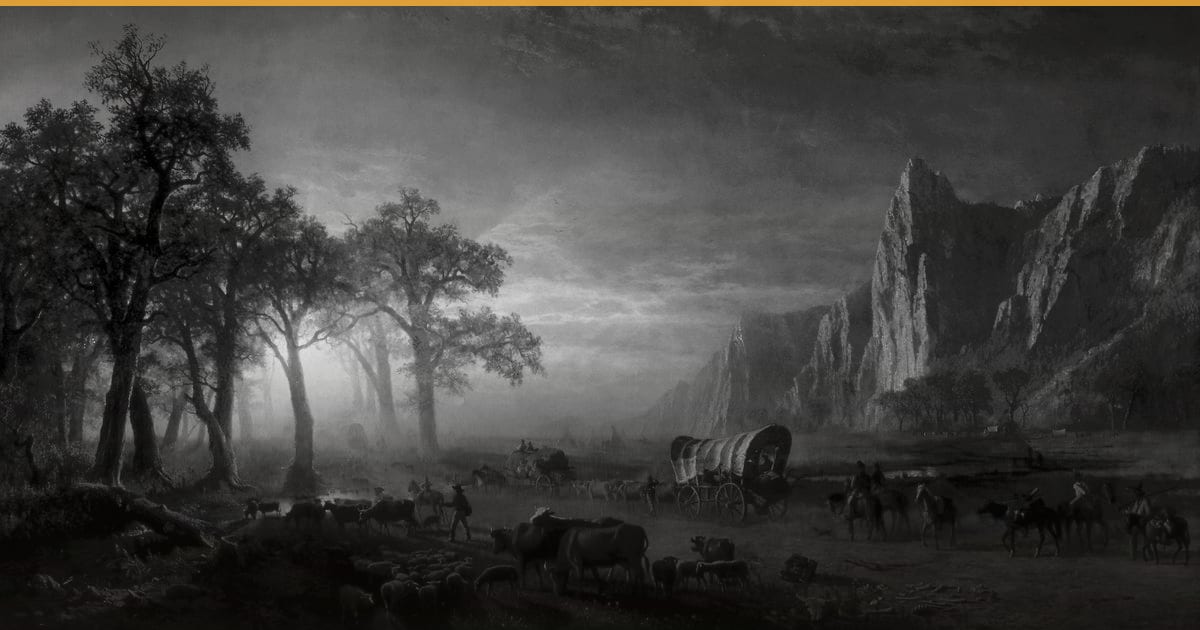
Independence was platted in 1827 as the seat of the brand-new Jackson County, and within a few years geography handed it a role it would play for a generation: it became the jumping-off point for the overland trails — the town they came to call the Queen City of the Trails. The first migrant wagon train bound for Oregon rolled out of Independence in 1843, and over the following decades something on the order of 400,000 people set out on the great western trails — the Santa Fe, the California, and the Oregon. Not every one of them left from Independence; that vast migration flowed through several outfitting towns over the years. But in the early trail era Independence was the principal jumping-off point, the place the guidebooks named, and by the city's own reckoning all three of those trails began here.
That is an almost unimaginable amount of human traffic for a frontier town, and every bit of it had to be supplied. You did not set out across the plains on hope. You outfitted first — wagons, oxen, flour, bacon, powder, lead, tools — and you did it here, on and around this Square, from merchants and freighters who made their living off the westbound flood. The Santa Fe trade in particular was a serious commercial enterprise, moving thousands of wagons and thousands of tons of goods south into Mexico, and Independence was its eastern anchor.
Whiskey on the Loading List
So where does the whiskey come in? Right on the manifest.
When historians describe the freight that left this region for Santa Fe, the list is remarkably consistent: flour, whiskey, hardware, and ammunition — packed in boxes, sacks, and barrels — along with dry goods and machinery. Whiskey wasn't a footnote. It was a staple trade good, hauled south to be sold in Santa Fe alongside everything else, and carried west by emigrants as provision, medicine, currency, and comfort.
On the trail, whiskey did jobs we now hand to a pharmacy and a bank. It was rubbed on aches and dosed for fevers (its actual medical value was mostly in the believing, but believe they did). It greased negotiations and sealed trades. It warmed men through plains nights and steadied them before hard crossings. A barrel of whiskey was a genuinely useful thing to own on the far edge of settlement — sometimes more liquid, in every sense, than the coins in your pocket.
What Was Actually in the Barrel
Here is where we tell the truth about the romance, because this is a cocktail lounge and we owe you the real version.
The whiskey that left Independence was, by and large, nothing like what we pour today. This was mostly young, raw grain spirit — often only lightly aged or not aged at all, frequently "rectified," which is a polite nineteenth-century word for cut, doctored, colored, and flavored by middlemen to stretch the volume and fake the maturity. Caramel for color, additives for bite, whatever it took to sell rough spirit as something finer. There were no federal standards worth the name. When you bought a barrel of frontier whiskey, you were, to a real degree, trusting a stranger about what was in it.
That problem — the near-total absence of any guarantee of what was in the bottle — is not a small side note. It became the whole reason the government eventually stepped in with the Bottled-in-Bond Act of 1897, the first real quality guarantee in American whiskey. We'll tell that story later in this series. For now, just hold the contrast: the whiskey we get to nose and sip and trust today exists precisely because the whiskey that left this Square so often couldn't be.
The Town That Got Overtaken
Independence didn't hold the crown forever. The town's river landings — the ports on the Missouri where the steamboats met the wagons, a few miles north — were vulnerable to the river itself, and a major flood in 1844 silted up the approaches and pushed the boats farther west, toward Westport Landing, the muddy rock ledge that would grow into Kansas City. The railroads finished the job later in the century. The center of gravity slid west, and Independence gradually handed off its outfitting role to the younger city downriver.
But for that shining stretch of the 1830s, '40s, and into the '50s, this was the place — the last well-stocked store before the frontier swallowed you. The people who built the American West stood about where you're standing and bought what they'd need. And a fair amount of what they needed came in barrels.
Drink Like the Frontier (Carefully)
We'll pour you something that honors that rough, honest, unpretentious past — without actually making you drink 1840s rectified rotgut, because we like you.
Try a glass of McCormick Platte Valley Corn Whiskey. Corn whiskey is the closest honest cousin to what much of the frontier actually drank — young, corn-forward, unfussy, closer to the barrel than to the boutique. And there's a fitting bit of geography in it: McCormick's roots run to Weston, Missouri, just up the river, part of a distilling story we tell later in this series. It is the frontier in a glass, cleaned up just enough to enjoy on purpose.
Raise it to the outfitters and the freighters and the four hundred thousand souls who loaded their wagons on this Square and pointed them at the horizon. They took whiskey with them for a reason. So can you — just up the street from where they bought theirs.
Next in the series: Prohibition comes to Jackson County — and the county, under Boss Tom Pendergast, cheerfully ignores it.