
What Stood Here Before: The History Beneath 208 W Lexington
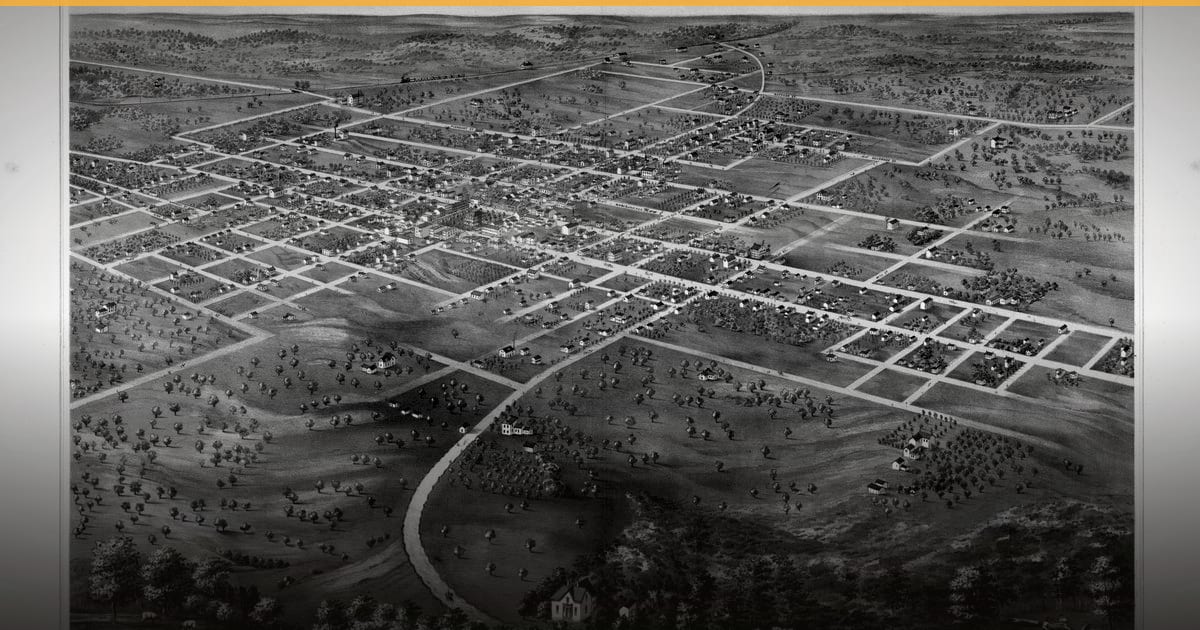
The lounge you are sitting in has a past, and it is older than almost anything else you can name in this part of Missouri. We pour American whiskey at 208 West Lexington Avenue, on the south side of the Independence Square — a public space that was surveyed and staked out in 1827 — when John Quincy Adams was president, and the wagon trains had not yet left for Oregon. (The county around it took the name of Andrew Jackson, then still two years shy of the White House.) Most bars trade on being new. This one sits on a block whose story runs back nearly two centuries.
This is the second piece in our series on Kansas City whiskey history, and it is the closest to home — a biography not of a person but of a place: our own address, our own block, and the Square it faces. We'll show you how a building's past is actually read out of the public record, and then we'll read ours. Some of what turned up is so on-the-nose you'll think we made it up. We didn't, and we'll show you the sources.
How You Read a Building's Life
Start with the method, because it is the honest part. A building does not keep a diary. To reconstruct what stood on a given patch of ground, you assemble it from documents that were created for entirely unromantic reasons — taxes, insurance, lawsuits, and mail delivery.
Four sources do most of the work, and the City of Independence's own Historic Preservation Division will point you to every one of them:
- Sanborn fire insurance maps. From the 1870s into the 1950s, the Sanborn Map Company drew block-by-block, building-by-building maps of American towns so insurers could price fire risk. They are the single most productive record of what physically stood where — footprints, construction material, even the use of each storefront — and they were redrawn every decade or two, which means they document change. Independence was mapped by Sanborn; a surviving sheet from August 1916 sits in the Library of Congress collection, and the full run is available digitally through the Mid-Continent Public Library's Midwest Genealogy Center.
- Deed and chain-of-title records. Every transfer of the ground itself is recorded by the Jackson County Recorder of Deeds. You trace ownership backward, link by link — the "chain of title." There is a small, perfect irony here: that office sits at 112 West Lexington Avenue, in the Truman Courthouse, a two-minute walk from your seat. The record of who owned this ground is filed a hundred yards up our own street.
- City directories. Organized by address since the 1930s, these list the resident or business at each number — the closest thing to a year-by-year roll call of who was actually here.
- Property abstracts. Compiled bundles of every legal document touching a parcel; when an owner hasn't kept theirs, the Jackson County Historical Society sometimes has a copy.
That is the toolkit. We ran it on our own address. Here is what came back.
The Square Is Born, 1827
Independence was platted and founded in 1827, laid out as the seat of Jackson County, which had been organized the year before. The first thing the new county built was a courthouse — a log structure, the first government building in Jackson County, and by the city's own account the only courthouse standing between here and the West Coast for the next forty years. The Square was not decoration. It was the civic and commercial heart of a county, and the buildings that rose around its four sides existed to do business with the people who came to the courthouse.
In 1836 the county replaced the log building with its first brick courthouse on the Square. That brick courthouse is, in a sense, still here — it was renovated and enlarged repeatedly over the next century, and its current Colonial form is a 1933 remodel carried out under the leadership of a local presiding judge named Harry S. Truman. (We told his story in the first piece of this series. He is never far away on this Square.) The building at the center of your view has been continuously rebuilt rather than replaced — a useful thing to remember when you wonder about the buildings around it.
The Busiest Corner on the Frontier
For a stretch of the 1840s and 1850s, the ground around you was about as commercially busy as anywhere west of the Mississippi. Independence had become the jumping-off point for the overland trails. The first migrant wagon train left for Oregon in 1843, and by the city's reckoning something on the order of 400,000 people eventually departed from Independence on the Santa Fe, California, and Oregon trails. They outfitted here first — wagons, oxen, flour, powder, and, yes, whiskey by the barrel (a story we take up in the next installment).
What that means for our block is simple: the storefronts facing the Square in those decades were outfitters, merchants, grocers, and tradesmen serving a flood of westbound travelers and the freight trade to Santa Fe. The big freight wagons rolled past the courthouse square loaded for the Southwest. A commercial building on West Lexington in 1850 was a building making its living off that traffic. The arrival of the railroad — the Chicago & Alton depot was built in 1879 — eventually reshaped how goods and people moved, but the Square remained the town's commercial center.
The Building You're Sitting In: The Street Building, 1908
Our building has a name, and a maker. It is The Street Building, and it was raised in 1908 by a master brick mason named William F. Street.
Street was a St. Louis man, born in 1860, who learned the brick trade there and came to Independence around 1883. He was a builder and a brick manufacturer — he made the material and then laid it — and he left his mark all over this part of town. The building you're drinking in was one of his last: a two-story brick commercial block, three storefronts on the ground floor and apartments above, in a brownish-red brick flecked with dark orange and cream, under a roof that slopes quietly toward the back. He did not quite live to see it weather in. Street died in 1910, two years after he finished it.
There is one more detail in the historic survey record of this building that we love, because it makes the point of this whole article in a single line: when Street built in 1908, he incorporated the rear and side walls of the building that already stood on this lot. So the structure around you is not the first thing to occupy this ground — it was grafted onto something older still. There are older bricks inside these walls than the ones with Street's name on them.
What Actually Stood at 208 — And Why You'll Smile
Now to the specific door. Here is what the Sanborn maps and the building's historic survey record show standing at 208 West Lexington and its two sister storefronts, decade by decade:
- 1911 — next door at 210, Owen Dry Cleaning.
- 1916 — at 212, a tobacco shop and newsstand and a tailor; and at 208 — our address — a restaurant. A room serving food and drink on this exact spot, one hundred and ten years ago. The hospitality trade has been the business of this storefront since before Prohibition.
- 1920s–1930s — city constables lived in the second-floor apartments overhead, and the ground floor housed two tenants whose names are going to stop you: the Marinello Shop and the Sentinel Publishing Company.
Read those last two again. The whiskey library and cocktail lounge at this address is called The Sentinel Room — and the storefront beside us, the one that has traded as the Marinello, is being brought together with it as the Sentinel Parlor, the welcoming room where guests first step into the library and lounge. Nearly a century ago a publishing company called Sentinel set type on this ground floor and a Marinello shop traded next to it; soon the Sentinel name will stand over this door twice, and that old Marinello space becomes the threshold you walk through first. We did not borrow these names from nowhere — we pulled them back up out of the building's own record. You are, quite literally, drinking where the Sentinel was once printed.
We'll be straight about the seams, because that's the house rule: the record is loud in some decades and faint in others. We can't yet narrate every tenant between the constables of the 1930s and the lofts and lounge of today, and the identity of the pre-1908 building whose walls Street kept is a deed-chain afternoon still waiting at the Recorder's office up the street. But the spine of the story is solid and sourced — a 1908 brick building on older bones, a restaurant at 208 by 1916, and a Sentinel on the ground floor between the wars. History rarely hands you a rhyme this clean.
Across the Street, the Record Is Loud
For all the quiet around our own front door, the building directly across Lexington Avenue from us has one of the best-documented moments in Jackson County's political history — and it is the reason the first article in this series exists.
At 211 West Lexington, in an upstairs room, the Rural Jackson County Democratic Club — the eastern-county arm of the Pendergast organization — held its meetings. At a gathering of that club in the spring of 1922, Mike Pendergast stood up and named an obscure local haberdasher as the machine's candidate for Eastern Judge of the county court. The haberdasher was Harry Truman, and the announcement set in motion a career that ended in the White House. The club also used a space at 111½ West Lexington, which served as Truman's 1922 campaign headquarters; by the Truman Library's account that building is gone, while 211 still stands.
Step out our door, look across the street, and you are looking at the room where a president's path began. The history we can't fully see on our own side of Lexington is blazingly well-lit on the other. That is the nature of the record: it illuminates unevenly, and the honest historian works with the light that exists.
Why It Matters That It's Old
There is a reason we keep coming back to the age of this place. Whiskey is a drink about time — grain into spirit into something patient in a barrel for years before it's poured. It belongs in a room that has kept time the same way. The Square outside has watched a log courthouse become a brick one become a Colonial one; it has watched outfitters become railroads become the quiet, handsome district it is today. William Street's walls — wrapped around someone else's older walls — have stood through most of it, sheltering a restaurant, a dry cleaner, a tailor, a few constables, and a little newspaper called the Sentinel.
So come sit in it. Take a stool where the Sentinel once ran its press, order a glass of J. Rieger & Co. Kansas City Whiskey — from a Kansas City whiskey house the city built, Prohibition erased, and a later generation brought back to life — and drink to the idea that nothing here is really gone. It's just waiting in the record for someone to come read it. The bricks are over a century old. The deeds are filed two minutes up the street. And the name on the door turns out to have been here all along.
Next in the series: the whiskey town before the trails — Independence as the great frontier supply hub, and what was really in the barrels that left for Santa Fe.