The City That Never Closed: Prohibition, Pendergast, and Kansas City's Speakeasy Years
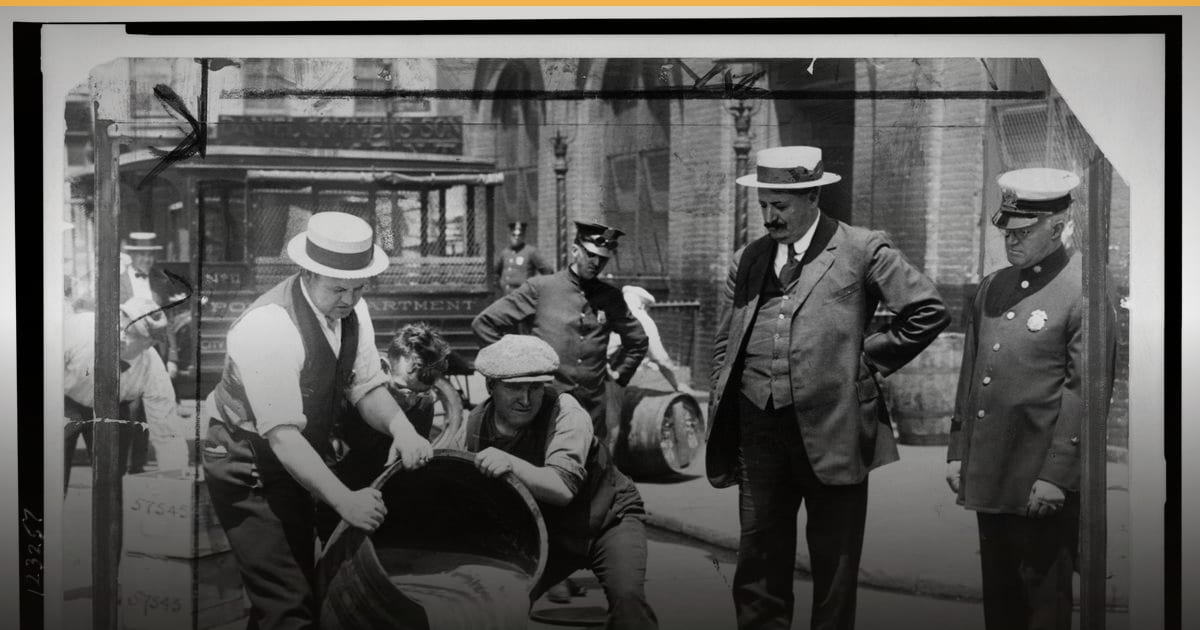
For thirteen years — from 1920 to 1933 — it was against the law of the land to sell you the drink now sitting in front of you. National Prohibition banned the manufacture and sale of alcohol across the entire United States. Bars closed. Distilleries shuttered. An entire American industry went dark, or underground, behind hidden doors and muttered passwords.
Except here. In this county, almost nobody noticed.
This is the fourth piece in our series on Kansas City whiskey history, and it's the one where the whole metro plays the outlaw. Because while the rest of the country was learning the word speakeasy, greater Kansas City — Independence included, this Square included, all of it Jackson County — ran wide open, poured freely, and turned a national ban into a local punchline. To understand the whiskey we get to enjoy openly today, you have to understand the thirteen years we technically weren't allowed to.
A State That Never Wanted It
Start with the fact that Missouri never asked for Prohibition in the first place.
Long before the national ban, when the temperance movement was pushing dry laws state by state, Missouri voters were handed the question directly — and turned it down flat, not once but three times, in 1910, 1916, and 1918. This was a brewing-and-distilling state with deep German immigrant roots, especially along the Missouri River, and it had a settled, unbothered relationship with a glass of beer or a shot of whiskey. When the 18th Amendment finally arrived in 1920, it arrived over the objections of a population that had already said "no thanks" three separate times.
(We'll be fair to the record: it's more complicated than "wet Missouri." By World War I, local-option laws had already gone dry in the large majority of Missouri's counties, and the state legislature did eventually ratify the 18th Amendment — though only after it had already passed elsewhere. Missouri was not uniformly wet. But its big river cities, and Kansas City above all, were another matter entirely.)
Boss Tom's Wide-Open Town
The reason Kansas City ignored Prohibition has a name: Thomas J. Pendergast, the political boss whose machine controlled the city and much of Jackson County. Pendergast had come up through the saloon and wholesale-liquor trade himself (his story is the next article in this series), and under his rule — at its height from roughly 1925 to 1939 — the machine simply declined to enforce the law it disliked.
It did this the direct way: by owning the enforcers. The Pendergast organization worked in lockstep with a police force on its payroll, along with cooperative city officials and prosecutors. Saloons stayed lit. Liquor kept flowing. Gambling and nightlife boomed. The city earned its nickname — the "Paris of the Plains," a wide-open town — and wore it proudly.
You want a single statistic that captures it? It is often said that during all of Prohibition there was not one alcohol-related arrest in Kansas City — a claim so extreme it sounds invented, and one worth treating as the era's defining boast rather than a courthouse-audited number. True to the decimal or not, it tells you exactly how seriously the ban was taken here: not at all.
The Wettest Block in the World
Kansas City's wet reputation didn't begin with national Prohibition — it was decades in the making, and that's the key to the whole story. A generation earlier, after neighboring Kansas went dry in 1881 and thirsty Kansans simply crossed the state line to drink, a stretch of the West Bottoms near 9th and State Line earned a nickname that stuck: "The Wettest Block in the World." By the accounts that survive, some twenty-five saloons and liquor retailers packed that single block, filling all but two of its storefronts. That was well before 1920 — but it was the DNA of the place.
So when national Prohibition arrived, Kansas City wasn't being asked to stop something new. It was being asked to abandon a way of life it had been perfecting since before the turn of the century — and it flatly declined. The saloons that had made the West Bottoms notorious didn't vanish in 1920; the drinking just kept going, now technically illegal and entirely unbothered.
That easy, unhidden availability of liquor is also, not coincidentally, why Kansas City became one of the great incubators of American jazz in these same years — the clubs never closed, the musicians always had paying rooms, and the sound that came out of the 12th Street and 18th & Vine districts changed American music. That's a story big enough for its own article, and it gets one later in this series. For now, just hold the image: a city where the "speakeasy" barely bothered to whisper.
Independence in All This
It's tempting to file this as a Kansas City story and leave our own town out of it, but Independence sat squarely inside the same machine and the same county. This was Pendergast's Jackson County, top to bottom.
And here is the thread that ties it back to the very first article in this series: the young man who would become President of the United States was, during these exact years, a rising official of that machine — Harry Truman won his first race for Eastern Judge of the Jackson County Court in 1922, launched from a room at 211 West Lexington, directly across the street from where you're sitting. Truman was, by every serious account, personally honest and never a bootlegger. But he built his career inside the same organization that was keeping the county wet, and he came out of a Missouri that had told Prohibition "no" three times. The man and the moment were cut from the same cloth.
When the Ban Ended, Nothing Happened
National Prohibition was repealed on December 5, 1933. In most of the country, that was a seismic event — the return of legal liquor. In Kansas City, it was an anticlimax. Liquor had never really left. The main practical effect was that prices dropped and the machine lost a revenue stream, because there was no longer any reason to pay for protection you didn't need. Kansas City kept its wide-open reputation well into the 1960s. The "dry" years had changed the paperwork, not the pour.
There's a lesson in that for anyone who likes a drink and likes honesty: you cannot ban a thing a community has decided it wants. You can only drive it into the dark for a while. Kansas City just declined to turn off the lights.
Pour One in the Open
So here's to drinking in the open — a small civic freedom that this Square did not actually surrender even when the law said it must.
Let us pour you something that wears the era on its label: Old Forester 1920 Prohibition Style, a bourbon built to taste like the barrel-strength whiskey Old Forester bottled during Prohibition itself, when it was one of the very few distilleries permitted to keep operating under a federal license for "medicinal" whiskey. It is Prohibition in a glass — the exception that proves the ban — and you can drink it here, out loud, no password required.
That's the whole point. Pull up a stool where the Sentinel once ran its press, in a town that never really went dry, and raise one to the city that never closed.
Next in the series: the man himself — Boss Tom Pendergast, the saloon-keeper's son who ran a wholesale liquor empire and a political machine at the same time, and put a future president in office along the way.