
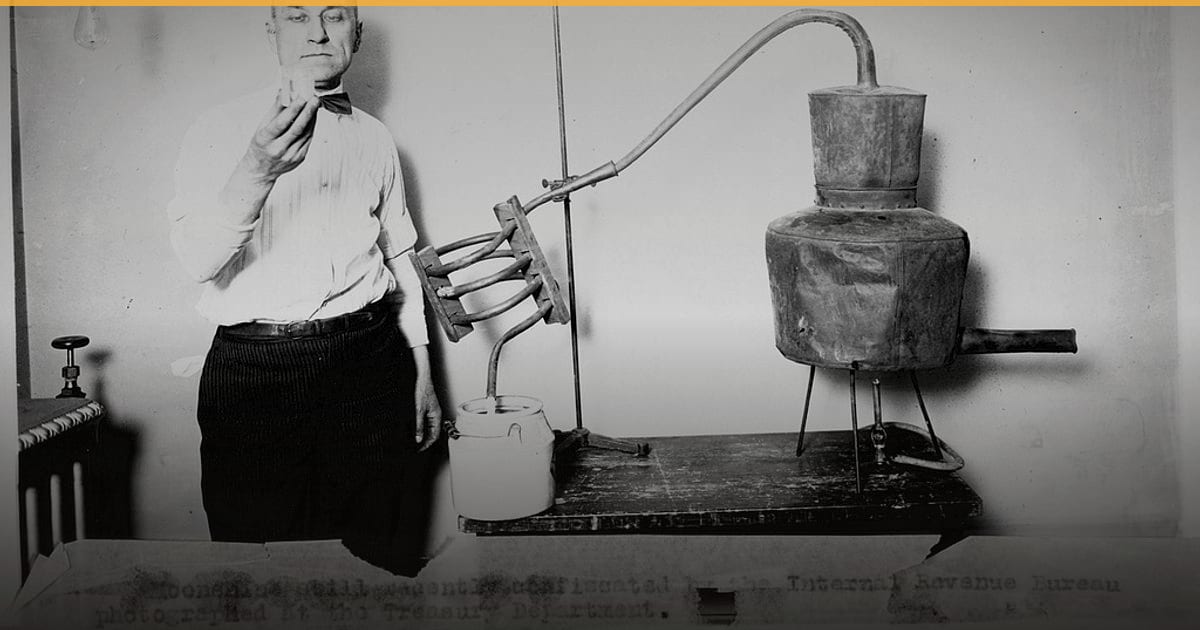
Sugar, Stills, and the Truth About Ozark Moonshine
The whiskey that kept Kansas City wet during Prohibition didn't all come from behind a bar. A great deal of it came out of the ground — corn, mostly, cooked over hidden fires in the rural hills to the south and hauled toward the thirsty city. Moonshine is the supply side of the wide-open-town story we've been telling: while Boss Pendergast's Kansas City drank in the open, somebody had to make all that illegal liquor. Often it was a hill farmer with a still and a reason.
This is the ninth piece in our Kansas City whiskey history series, and it comes with a warning label: no subject in American whiskey is more thickly wrapped in folklore than moonshine. So we're going to give you the documented version — which, as it happens, is stranger and more interesting than the legends.
Why the Hills Made Whiskey
Ozark moonshining wasn't a criminal invention. It was a folk craft, carried into the region by Scots-Irish settlers who had been making whiskey for generations, dropped into a landscape that was, in the words of one historian, "a land of corn." Put an old distilling tradition together with abundant corn and cash-poor hill farms, and you get moonshine as a matter of simple economics.
The economics are the key, and they're beautiful in their logic. A hill farmer with a wagonload of corn faced brutal transport costs and thin markets — corn was cheap and heavy and hard to get to town. But distill that same corn into whiskey, and suddenly it was worth more per gallon than the raw corn was per bushel, light enough to haul, and it never spoiled. Whiskey was how a corn-poor farm turned a crop into cash. During Prohibition and the Depression that followed, with legal work scarce and legal liquor illegal, production hit its peak. A gallon of moonshine could fetch around $12 during Prohibition — roughly two full days' wages for a laboring man. You can see why a family with a still and a spring did the math.
The Kansas City Connection Runs on Sugar
Now here is the documented surprise, and it's better than any midnight-hauler legend.
You'd expect Kansas City's moonshine racket to be a story about liquor moving up the roads from the Ozarks. But the best-documented Prohibition supply network in Kansas City wasn't about hauling whiskey at all — it was about sugar. Making whiskey fast and cheap, the way city "alky cookers" did, took enormous quantities of corn sugar and yeast. And in Kansas City, brothers Joseph and Peter DiGiovanni — "Joe Church" and, wonderfully, "Sugarhouse Pete" — ran what became known as the "Sugar House Syndicate," cornering the corn-sugar supply and selling the raw ingredient to the operations that did the distilling.
Control the sugar, and you controlled the shine. It's a perfect piece of Prohibition economics: the smart money wasn't necessarily in the still or the delivery run — it was in owning the one ingredient everybody needed. The KC booze empire, in its most documented form, ran on sugar.
What We Won't Tell You
This is the part where a lot of whiskey writing goes off the rails, and we're going to stop at the edge of the cliff on purpose.
You will find, all over the internet and in tourism copy, colorful specifics: named smugglers running named routes from named hollows to particular Kansas City speakeasies, tunnels under the city, Al Capone personally supplying Kansas City, and various too-perfect anecdotes. We're not going to repeat those, because when you actually chase them to a source, they mostly evaporate into legend. The reliable record connects the rural Ozark countryside to urban demand only in general terms; it does not give us a verified map of who hauled what down which road. Some of the most-repeated moonshine "facts" — including certain figures that actually belong to Franklin County, Virginia, not Missouri — are simply misattributed. We'd rather hand you a smaller true story than a bigger false one.
What we can stand behind: the enforcement was real and relentless. In the decades after Prohibition, federal agents seized on the order of six thousand stills across Missouri and Arkansas — a number that tells you the hills never really stopped, long after the cities went legal.
From Outlaw Fire to Legal Shelf
The word "moonshine" has no legal definition — it just meant untaxed, illicit corn liquor made by the light of the moon. The grain that defined it was corn, and corn is still the through-line: the legal category that descends from all those hidden stills is corn whiskey, a spirit from a mostly-corn mash (at least 80% corn by law). Uniquely, corn whiskey doesn't have to see a barrel at all — the clear, unaged "white dog" that runs off the still is legal to bottle as-is. But most of what reaches a good shelf today has been given something the moonshiner rarely had the time or patience for: a few honest years in oak.
Which means you can now taste the outlaw tradition — cleaned up, aged, taxed, and labeled — without breaking a single law or trusting a single stranger about what's in the jar.
Pour the Corn
Let us pour you the legal, grown-up descendant of all that hill-country ingenuity: a glass of McCormick Platte Valley Corn Whiskey — a straight corn whiskey rested a few years in oak — or, for the craft-Missouri take, Wood Hat's Aged Blue Corn Whiskey, matured in toasted oak to a soft amber. Corn-forward and close to the source, but with the patience the old shiners couldn't afford. It's the moonshiner's grain, done the way you'd do it if you weren't running from the law.
Raise it to the hill farmers who turned corn into cash, and to "Sugarhouse Pete," who understood that the real money was in the sugar. The moonshiners were, whatever else you think of them, some of the most stubbornly entrepreneurial people this state ever produced. We'll drink to that — legally, and with a little more oak than they managed.
Next in the series: we follow the whiskey down to the water, and the great river highway that carried it all west.