
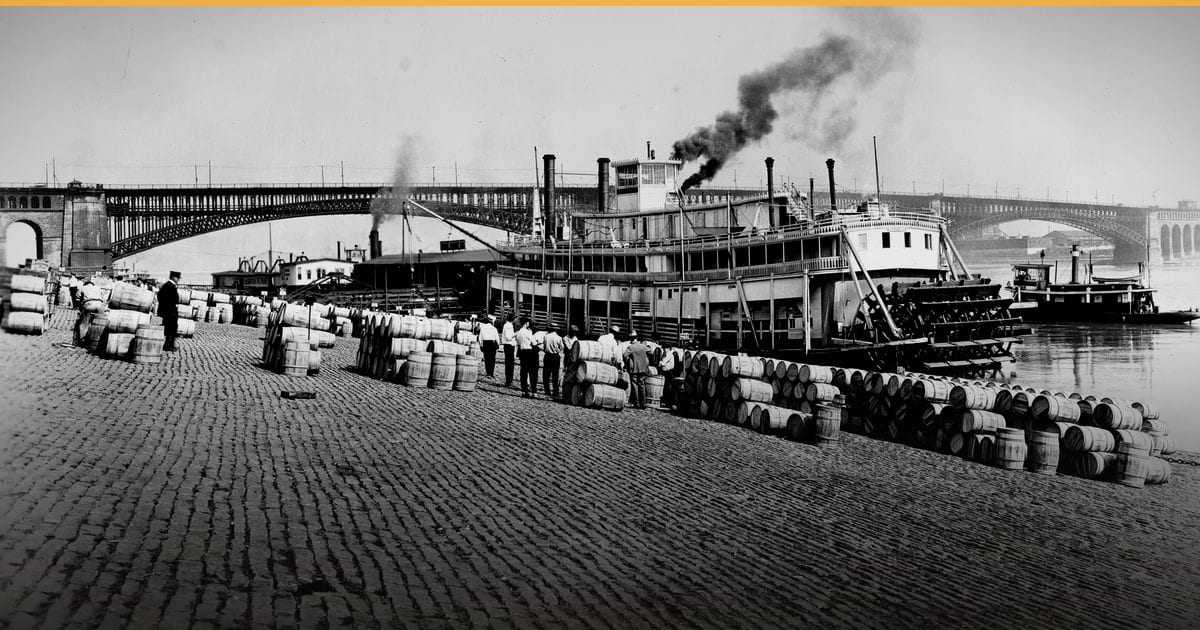
How the Missouri River Moved the Whiskey West
The whiskey on our shelves arrives by truck, on interstates that trace, more or less, a much older highway: the Missouri River. Before the roads and the rails, the river was the road — the great brown highway that carried the whole westward enterprise, barrels of whiskey included, into and out of the frontier. And the story of how it did that is also the story of how Kansas City came to eclipse Independence, decided in the end by a single flood.
This is the tenth piece in our Kansas City whiskey history series, and it follows the whiskey down to the water.
The River Was the Interstate
In the first half of the nineteenth century, moving heavy freight overland was punishing and slow. The Missouri River let steamboats carry goods deep into the interior, and the closer to your destination you could float a barrel before loading it onto a wagon, the better. Traders using the landings near the river's big bend in Jackson County gained a real edge — they could avoid roughly a hundred miles of miserable, unimproved road by freighting their goods that much farther upriver first.
So the river landings became the hinges of frontier commerce. Whiskey, flour, hardware, and ammunition came up the Missouri by steamboat, got offloaded at a landing, and were transferred to wagons for the overland haul to Santa Fe or Oregon. The whole outfitting economy we described earlier in this series depended on that water-to-wagon handoff.
Independence Had a Seaport (a Few Miles Away)
Here's a detail that surprises people: the great outfitting town of Independence didn't actually sit on the river. The steamboats couldn't reach the Square. So Independence's commerce depended on landings a few miles north on the Missouri — the town's "seaport," sitting out on the bluffs.
The main one was Wayne City Landing (also called Upper Independence Landing), named for an Army lieutenant who had camped on those bluffs in 1825; by the 1830s it was the closest Missouri River landing to Independence, and traders paid to ship their wares there and cart them into town and onward. A little upriver was Blue Mills Landing, a preferred steamboat stop by 1834, complete with a big warehouse for the water-to-land transfer and mills owned by prominent Santa Fe traders. Barrels of whiskey bound for the frontier came off the boats at places like these, rolled onto wagons, and started their overland journey — a mile or more from the Independence storefronts that sold them.
The Flood That Built Kansas City
Now the turning point, and it's a good one, because it hinges on the river's own temper.
A little way downriver, in the spring of 1834, a settler named John Calvin McCoy had established a rough landing at a rocky ledge a few miles north of the village of Westport. It was serviceable but unglamorous — a muddy shelf where boats could tie up. For a while it was just an alternative to the busier Independence-area landings.
Then, in 1844, the Missouri did what the Missouri does: it flooded, massively. The high water and the sandbars it left behind fouled the approaches to the Independence-area landings, and the steamboats, needing reliable places to dock, shifted their traffic downriver to Westport Landing — McCoy's muddy rock ledge. That landing grew into the Town of Kansas, incorporated as the City of Kansas in 1853, and eventually into Kansas City. A flood had quietly begun to move the region's center of gravity from Independence to the younger settlement downriver. Whiskey and everything else followed the boats.
A Word on the Whiskey Trade's Darker Edge
Honesty requires one hard note. The frontier liquor trade had an illegal and destructive side that we won't paper over: the sale of whiskey to Native nations. Federal law — the Trade and Intercourse Acts, with the key restriction made permanent in 1834 — prohibited introducing "ardent spirits" into Indian country, carrying stiff penalties, including a $1,000 fine and destruction of any illegal still. That trade nonetheless persisted illegally along the frontier's edge, and it did real harm. It's part of the true history of whiskey moving west, and it deserves to be stated plainly rather than romanticized.
Then the Rails Buried the River
The river's reign didn't last. Railroads reached the region at mid-century, and the decisive blow came on July 3, 1869, when the Hannibal Bridge opened across the Missouri — the first railroad bridge over the river. That bridge cemented Kansas City, rather than its rivals, as the region's rail hub, and it began the long process of making river freight obsolete. The whiskey kept coming; it just increasingly came by rail, and then, eventually, by the trucks that bring it today.
The Missouri River is quieter now. But every bottle on our back shelves is the descendant of a barrel that once rode that water west, and the roads that deliver our whiskey still bend the way the river bends.
Pour One by the River
Fittingly, we'll pour you a whiskey that was born of this river city: J. Rieger & Co. Kansas City Whiskey, from the house that grew up in the West Bottoms hard by the river and stockyards trade (its full resurrection story is a few articles back in this series). It's a glass with the Missouri in its lineage — a Kansas City whiskey from the city the river built.
Raise it to the steamboats and the landings and the 1844 flood that quietly picked a winner. The river moved the whiskey west, and it moved a city while it was at it. Come drink to the current — we're right here on the ground it shaped.
Next in the series: the law that finally made whiskey honest — the Bottled-in-Bond Act of 1897, and why it mattered so much on a frontier full of fakes.