
The Stagecoach King's Whiskey: Ben Holladay and the Oldest Distillery Site West of the Mississippi
The oldest distillery site west of the Mississippi River is a short drive from this lounge — about forty-five minutes north, in the little bluff town of Weston, Missouri. It was founded in 1856, before the Civil War, by a man who would go on to run the largest overland transportation empire in the American West. The bourbon in your glass and the stagecoaches of the Old West share a founder. That is not a marketing flourish. That is just the history.
This is the seventh piece in our Kansas City whiskey history series, and it's the one where Missouri gets to claim some genuinely deep whiskey heritage — carefully, and with the superlatives held up to the light.
Ben Holladay, the Stagecoach King
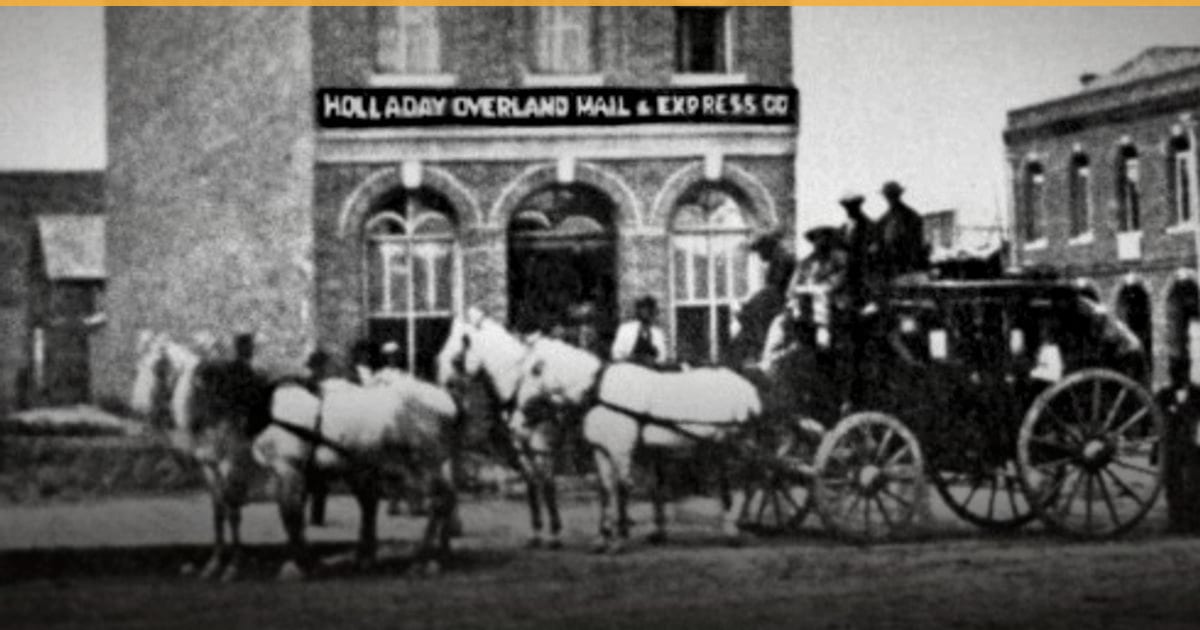
Ben Holladay (1819–1887) was one of the great characters of the nineteenth-century West. Born in Kentucky, settled young in Weston, Missouri, he built an overland freight and stagecoach empire so vast that at its height it reportedly ran on the order of 20,000 vehicles and employed thousands — carrying mail and passengers across the plains and Rockies, including the U.S. mail contract to Salt Lake City. They called him the "Stagecoach King," and the title was earned.
Then, in November 1866, with the railroads coming and the writing on the wall, Holladay sold the whole transportation empire to Wells Fargo & Company for a fortune in cash and stock — and got out at the top. (He later lost much of that fortune in the financial Panic of 1873, because the nineteenth century was like that.) But a decade before the Wells Fargo sale, back in 1856, Ben and his brother David had started something quieter and, as it turned out, far more enduring: a distillery in Weston, built over a limestone spring.
The Spring That Made It Possible
Whiskey towns are made by water, and Weston had the right kind. The distillery sits on a natural limestone spring — the same iron-filtering, mineral-rich limestone water that made Kentucky bourbon country famous, which is no small thing to find in Missouri. That spring, which local history associates with the route Lewis and Clark traveled through the area in 1804, still feeds the distillery today. Founders come and go; the water is the constant.
The Honest Version of "Oldest"
Now we have to do the thing this series always does, because Weston's history comes wrapped in a superlative that gets stated too loosely, and we'd rather you got the true version from us.
You will hear the Weston distillery called "the oldest continuously operating distillery west of the Mississippi." Be careful with that phrase. The defensible, accurate claim is narrower and still remarkable: it is the oldest distillery west of the Mississippi still operating on its original site. The 1856 site — that's the strong, true claim.
Where the wording breaks down is the word continuously. On-site distilling has not, in fact, been continuous. By the distillery's own history and independent accounts, on-site distilling stopped for roughly thirty years — from about 1985 to 2015 — when production was moved elsewhere and the Weston stillhouse sat idle while the company bottled and sourced whiskey rather than making it there. And the Prohibition years (1920–1933) are simply undocumented; the distillery's own master distiller has candidly admitted he has no records proving they distilled through Prohibition. The site survived; the distilling lapsed. Those are different things, and an honest history keeps them straight.
So here is the fair way to say it: a distillery site founded in 1856, operating on that same ground longer than any other west of the river, where on-site distilling lapsed for a stretch and then came roaring back in 2015. That's not a lesser story. It's a truer one — and frankly a better one, because it has a comeback in it.
The Ownership Chain and the Modern Revival
The distillery outlived a long line of owners — Holladay to Shawhan to, eventually, McCormick Distilling Company in 1942, the name many Missourians grew up with. For decades under McCormick the Weston operation was better known for bottling than for distilling its own flagship bourbon.
Then came the revival. On-site distilling resumed in 2015, the brand was relaunched as the Holladay Distillery in 2016 — its 160th anniversary — and in 2022 it released its first bourbon distilled on-site in the modern era: Ben Holladay Bottled-in-Bond Missouri Straight Bourbon, a six-year-old, 100-proof bourbon made and aged entirely in Missouri, meeting the strict standard of the 1897 Bottled-in-Bond Act (a law we'll devote a whole article to later in this series). It is, in a real sense, the 1856 distillery finally making its own name-brand bourbon again on its own ground.
Drink the Real Missouri History
This is the easy pour to recommend, because the subject of the whole article is on our shelf: a glass of Ben Holladay 1856 Bottled-in-Bond Missouri Straight Bourbon. Six years old, 100 proof, made in Weston over that limestone spring, bonded under the 1897 law. When you sip it, you're drinking the modern chapter of the oldest distillery site west of the Mississippi — founded by a stagecoach king, revived after a long sleep, and pouring again about forty-five minutes up the road.
And if the weather's good, go see it. Weston is a genuine day trip from Independence and Kansas City — a bluff town, a limestone spring, and a whiskey story that started before the Civil War. Then come back here and let us pour you the result.
Next in the series: the Kansas City whiskey house that Prohibition killed — and a great-great-great-grandson brought back from the dead.