The City That Swung All Night: Whiskey, Pendergast, and the Birth of Kansas City Jazz
The whiskey that made Kansas City jazz possible was poured a few miles west of this Square, in clubs that were breaking the law and not the least bit worried about it. That's the part people forget when they talk about the KC sound: it didn't come out of a conservatory. It came out of a wide-open town where the liquor never stopped and the bands played until the sun came up.
This is the sixth piece in our Kansas City whiskey history series, and it's the one where all that machine-protected, freely-flowing Prohibition liquor pays an unexpected dividend — one of the great flowerings of American music.
Why the Booze Mattered to the Music
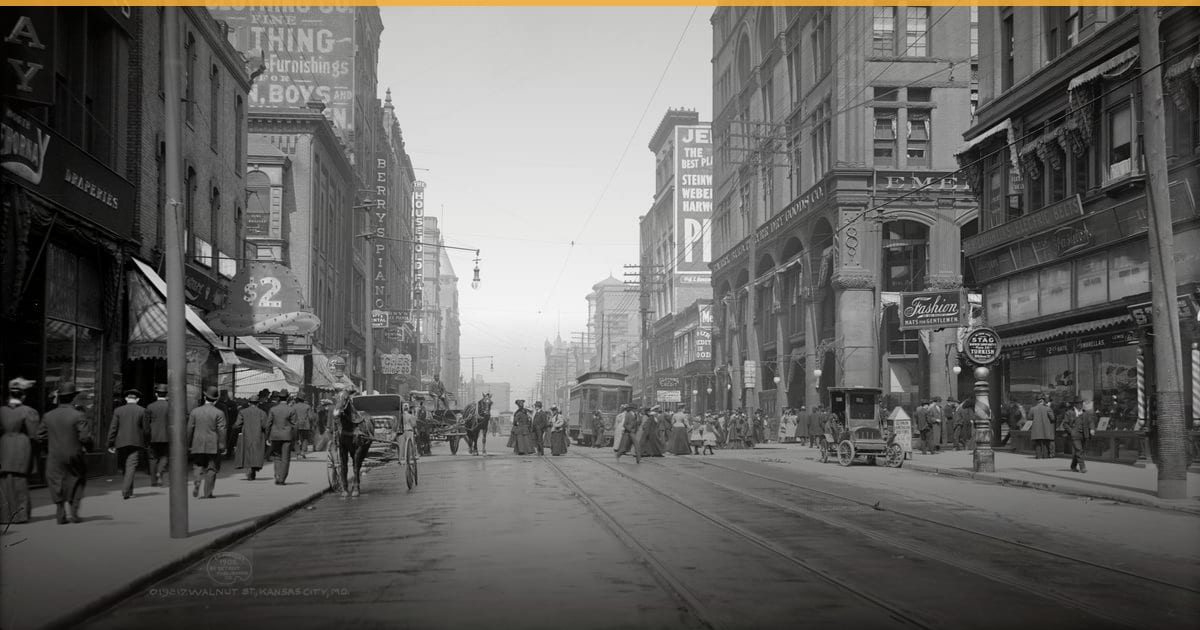
We've already told you (in the last two articles) how Boss Tom Pendergast ran Kansas City as a wide-open town from roughly 1925 to 1939 — police on the payroll, Prohibition openly ignored, liquor and gambling and nightlife running without interference. Here's the cultural consequence of all that corruption: the clubs never had to close.
In most of America, Prohibition drove nightlife into fearful, hidden, early-closing speakeasies. In Kansas City, the clubs ran dusk to dawn, in the open, because nobody was going to raid them. That single fact — round-the-clock, wide-open venues with liquor flowing — is why the KC jazz scene became what it did. Musicians could finish a paying gig and then head to an after-hours joint to play for themselves until morning. The paid work was steady, the jam sessions were endless, and the competition was ferocious.
12th Street and 18th & Vine
The scene had two hearts. 12th Street was the downtown strip of clubs near the machine's core. 18th & Vine was the center of the city's Black musical life — home to the nightclubs, the Mutual Musicians Foundation, and today the American Jazz Museum. Between and around them, historians count not a precise number but several hundred nightclubs and cabarets operating across the district in the era's peak. It was a staggering density of live music for one Midwestern city.
Out of that hothouse came a distinct Kansas City style — looser than the arranged big-band jazz of the East Coast, built on the blues, on riffs traded back and forth, on soloists stretching out over a swinging rhythm section. It was music forged in all-night jam sessions and in "cutting contests," where players dueled on the bandstand and a pecking order got settled in real time, at volume, in front of a drinking crowd.
The Names You Know
The talent that came through those clubs is close to the whole foundation of American jazz.
Bennie Moten led Kansas City's first great jazz orchestra and gave the city its early national voice, until his sudden death in 1935 during a tonsillectomy. Into that band, around 1929, had come a pianist named Bill Basie — Count Basie — who, after Moten died, formed his own band, took up residence at the legendary Reno Club on 12th Street, and rode experimental late-night radio broadcasts to national fame. Mary Lou Williams, one of the era's greatest pianists and arrangers, powered Andy Kirk's Twelve Clouds of Joy. Lester Young sharpened his revolutionary tenor saxophone in these cutting contests.
And a local teenager named Charlie Parker — born in 1920 in Kansas City, Kansas, and raised on the Missouri side — grew up inside this scene, absorbing it night after night before he went east and, with others, invented bebop. Kansas City didn't give Parker bebop. It gave him his education.
The Cymbal Heard 'Round the World
Here's the KC jazz story worth raising a glass to, and it's true in its essentials. As a teenager, Charlie Parker sat in at a jam session and got so thoroughly outplayed that the drummer, Jo Jones, pulled a cymbal off his kit and dropped it at Parker's feet — the bandstand's ultimate insult, a signal to get off the stage. The humiliation lit a fire. Parker went home and practiced with an obsessiveness that became legendary, woodshedding scales in every key until no one could ever gong him off a stage again. A few years later he reshaped the music entirely.
It's a perfect Kansas City origin story: genius, publicly embarrassed in a smoky club full of drinkers, turning shame into revolution. The clang of that cymbal is one of the great sounds in American music history — and it happened here, in the city that swung all night.
The Music Fades, the Sound Doesn't
When Pendergast fell in 1939 and the machine's protection evaporated, the wide-open town began, slowly, to close. Reform came. The clubs thinned. Many of the musicians followed the music east to New York, where the next chapters were written. The era had a beginning and an end, and both were tied to the machine.
But the sound never really left, and neither did the understanding of what made it: a city that refused to stop pouring. The whiskey and the music were never separate stories here. They were the same story.
Pour One for the Night Shift
So we'll pour you something with the neighborhood in its name: West Bottoms Whiskey Co. Kansas City Whiskey, from a distillery that takes its identity from the very district where Big Jim Pendergast first opened the saloon that started the machine that kept the music playing. It's a fitting glass to hold while you think about all those musicians who finished the paid gig and went looking for one more session.
Raise it to the players who kept Kansas City awake — and to the improbable idea that some of the best music America ever made came out of a town that simply declined to call last call. Come have one with us. We're happy to stay open a little later.
Next in the series: we follow the whiskey itself upriver, to the oldest distillery site west of the Mississippi — Ben Holladay's Weston, Missouri.